Trades in Stock Options. Receive daily trade recommendations. Can you imagine discovering a way to trade that promises instant income? If you think such a method is impossible, think again. It is definitely achievable, and everything you need to know is available online for one low price that includes special three-part online webinars.
Ambush is a time-proven mean-reversion day trading System focused on a variety of Futures markets around the globe. With Ambush Signals you can now easily follow the Ambush System on a subscription basis for educational purposes.
If you didn't fail early in your trading business, then you have probably been around long enough to realize that many of the problems you encounter as a trader are those that derive from your own individuality. Such problems are common among traders and, in fact, common among all human beings. Seeking spiritual help from a power much greater than your own is the area I address in the "Spiritual Side of Trading".
I am often challenged with regard to the Law of Charts. "How do you know it's a law?" The answer is that TLOC can be seen on any chart that has a range of values.
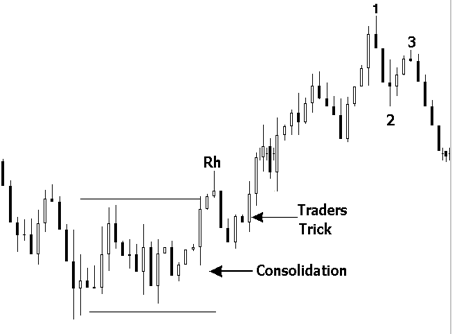
As I have often stated, the impetus for TLOC is the human action and reaction to the movement of prices. However, it is possible to see TLOC in action due to a variety of causes. The chart below shows what I mean.
This chart was produced by a random number generator using MS Excel. It really would have been nice for trading. In the future I want to show you another chart that proves TLOC is real. However, for now, please realize that TLOC is not a method or a system; it is a law. As with any law or precept, it is up to you as the trader to come up with a way to make money from the fact that TLOC will make patterns of consolidation, 1-2-3s, and Ross hooks.
Joe Ross knows trading!
Click on the links below to learn about his trading method!
Many traders underestimate the influence of stress. Stress is not only a psychological reaction, but a biological response as well. When you are stressed, your body reacts instinctively. You are agitated, on edge, and ready to lash out. Your attention is restricted. Your mind is closed and inflexible. The stress response has a specific biological, adaptive function: Your energy is channeled into making the simple response of fighting an opponent or running away. Not only is your energy channeled, but your perceptions are limited. Trading requires a more complicated skill set, though, and when you feel stressed out, you are bound to make a trading error.
It's surprising how stress can impact your ability to trade effectively. What's there to impact? Trading isn't that complicated, is it? Actually, there's a great deal that can happen. You can have a very complete trading plan, where every aspect is spelled out clearly, and you may have a wealth of experience executing such plans, but when you are stressed out, even the simplest task can be difficult to complete. You may not see an obvious signal to take action. And even when you see the signal, you can make a small mistake when you're stressed. Again, you are agitated and your psychological perceptions and intuition are restricted and closed off. You miss little things and have a tendency to respond quickly without thinking. While trading, we often do things automatically, without thinking, but stress can cause us to act so quickly that we miss something. We may forget to place an order according to plan or we may misread a signal and close out a position too early. These little errors can add up to disaster.
How can you beat stress? The most effective stress control strategies prevent stress before it happens. It is useful to minimize potential stressors. Getting into an argument with your spouse, for example, can put you in a bad mood that can escalate into an intense, distracting mood later in the day. Minor hassles can build up. For example, you may get cut off on the way to work, or the police may wrongly give you a traffic ticket. It can all add up, and set the stage for an incapacitating stress response. It’s important to acknowledge the power of these stressors, and when you feel agitated by them, you may want to stand aside until you feel better. Your trading environment can also impact your ability to handle stress. In many ways, trading is an art. You wouldn't try to create art in a noisy, chaotic environment, and you may not want to trade in such an environment either.
Trading requires an optimal mindset. When you are upset, tired, and emotionally distracted, you will have trouble following your trading plan. You must return to a calm, focused mindset, a mindset where you are attentive and alert, and can trade like a winner.
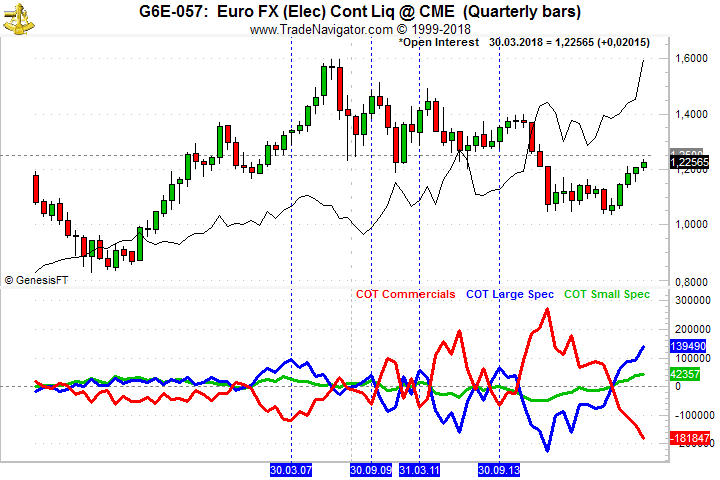
Today, I want to have a closer look at the Euro FX, especially at the all time net short position of the Commercials. While the COT report can give a trader some kind of “road map”, it is not meant to be a timing tool, as you can see on the chart below. The market did NOT turn around at the low levels of the COT Commercials chart (red line on the chart below), it took the market more time until it finally turned to the down-side. But not only the COT chart with the extreme levels look interesting, also the 1.2500 level is an interesting level because very often old support levels turn into resistance and vise versa. As I said before, I would not time my trades using COT (or seasonal) charts, but with possible resistance at 1.2500 we might see a lower Euro FX soon. On the other hand, if we move strongly above 1.2500 and the Commercials get caught on the wrong foot, we might easily see 1.4000.
Receive daily guidance from Andy Jordan! Traders Notebook Complete shows you Futures Trading Strategies in Spreads, Options, and Swing Trades. Learn step-by-step how to trade successfully.
After I mentioned that I’ve been doing trading the crypto currencies last year there’s been quite some feedback from you with questions about these new markets.
So I thought I’d share my thoughts about the crypto markets, my experiences regarding trading these and hopefully give you some useful tips on how to get started.
First of all, these crypto currency markets are still quite in the early stages of development. Volatility is often crazy, exchanges and brokers are still not fully established in terms of stability and features and every now and then there’s still something crazy happening like bitcoins getting stolen, exchanges going bust and so forth. It kind of reminds of the early days of retail forex trading even though the actual markets are completely different of course.
There’s Bitcoin Futures trading at the CME now but the liquidity isn’t really there yet. After having tried different crypto exchanges, I’m now using gdax.com which is quite well regulated and so far I’m having no issues at all trading there. Liquidity usually is very good and even when the markets go a bit crazy the platform works just fine. Another one that I didn’t try personally as it’s for US citizens only but that I’ve heard is good too is gemini.com.
Personally I still avoid having large sums of money at any of the crypto exchanges. To invest in a coin I do the trade at the exchange and then sent the actual coins to my electronic wallet instead of leaving them at the exchange. If I want to get out I sent the coins to the exchange, do the trade and withdraw the money back to my bank account. This way the risk of losing money when an exchange goes under is minimized.
New markets also have many advantages though, especially for us private traders. The biggest is that there’s less competition as the professionals aren’t in there yet. Even though there’s bitcoin futures trading at the CME now, hardly any of the very tough competitors you have in the currency or stock future markets are there yet.
This makes is quite easy to trade these markets if you’re used to trading much more difficult markets. They’re mostly driven by private investors and many well known strategies that stopped working in most markets long ago work very well in the crypto currency markets. One example are simple breakout and momentum strategies. When these markets start moving, they often do so in a very nice and "clean" way.
Happy Crypto-Trading!
Marco
Feel free to email Marco Mayer with any questions, This email address is being protected from spambots. You need JavaScript enabled to view it..
To view previous published Chart Scan newsletters, please log in or click on "Join Us,"
shown above, to subscribe to our free "Members Only" section.
A WEALTH OF INFORMATION & EDUCATION:
Joe Ross-Trading Educators' popular free Chart Scan Newsletter has been published since 2004.
Note: Unless otherwise noted, all charts used in Chart Scan commentary were created
by using Genesis Financial Technologies' Trade Navigator (with permission).
Legal Notice and Copyright 2018 Disclaimer - Published by Trading Educators, Inc.
Chart Scan is a complimentary educational newsletter.
I keep one of sorts, it is part of my monthly homework. The journal is very basic and includes...read more.
Receive daily guidance from Andy Jordan! Traders Notebook Complete shows you Futures Trading Strategies in Spreads, Options, and Swing Trades. Learn step-by-step how to trade successfully.
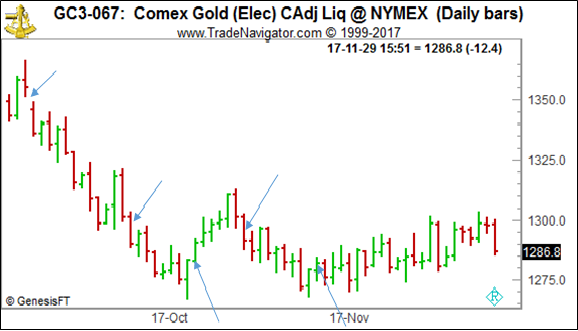
When economic times become volatile times, investors run to hard assets. Gold is a favorite hard asset in which to run, but keep in mind that gold loves to swing, even when it is trending. Recently, we've seen perfect setups for attempting to enter positions in gold based on the setups we teach at Trading Educators. The chart below shows exactly what I mean. The Law of Charts made it clear. I have shown where there were entry opportunities in gold. Three were short setups and two were long setups for short-term scalps. Trading gold, or silver should be obvious in times where people are looking for safe havens.
There are essentially two ways to "play" gold. One: Trade the swings in gold. Two: Buy and hold. Gold is most likely on its way to at least $5,000, and if we get the much anticipated “global currency reset,” we could easily see $10,000.
If we had a crystal ball, trading would just be a matter of buying at a bottom, holding the stock as the price continued to rise, and selling near a top, right before the public sells in a state of panic. But we don't have a crystal ball, and there is no foolproof way to forecast the markets. Sure, if you have enough capital, are willing to wait long enough for a stock price to increase, and will be satisfied with a small profit, you can identify a few key stocks that will pay off handsomely with a buy-and-hold strategy. But that isn't what you're looking for. If you are like most traders, you are trying to capitalize on short-term moves to make big gains over and over again, and in the long run, mount a series of impressive wins. To accomplish this goal, you need to control your impulses and emotions. You need to cultivate enough energy to study the markets and search for profitable setups. But the work doesn't end there. You also need to execute your trading plan with smoothness and agility.
A cursory review of history reveals a host of people who have fallen victim to self-sabotage. They range from presidents Ulysses S. Grant to Bill Clinton, from Charles M. Schwab of U.S. Steel to Dennis Kozlowski of Tyco International. These individuals rose from humble beginnings to accumulate wealth, fame, and power. Yet in the end, they took extreme risks and paid a steep price. Upon hearing their stories, it's tempting to think they had a motive for self-sabotage, a hidden demon ready to undermine all that they had accomplished.
Most of the articles in Chart Scan are about gaining a mental edge, and when you trade with a mental edge, you increase your odds of winning. This sentiment is expressed by the many trading experts. By understanding your motives and setting goals, as well as consciously controlling your state of mind, you can manage anxieties, focus concentration, and enhance our confidence as traders. In addition, by using specific psychological skills you can greatly improve your performance. These skills will increase your level of personal enjoyment and fulfillment.
At Trading Educators, we try to bring you knowledge from our own journey through life as a trader. We would like this opportunity to thank you for reading, and allowing us to help you master the markets and be the best trader that you can be. If you set realistic goals, work hard to gain market experience, and manage your mental state, you will be one of the few who become a winning trader.
Philippe Gautier: Administration and New Developments
Developer: Joe Ross
SSYS TRADE
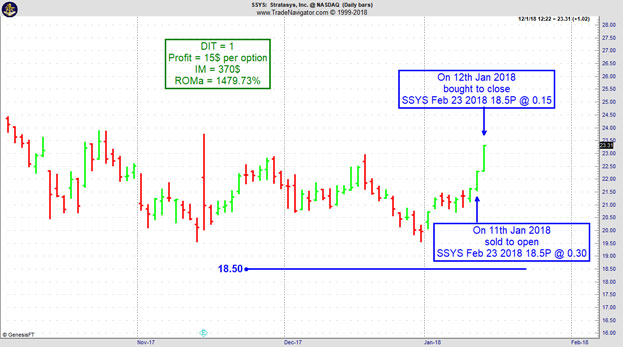
On 10th January 2018 we gave our Instant Income Guaranteed subscribers the following trade on Stratasys Inc (SSYS). Price insurance could be sold as follows:
On 11th January 2018, we sold to open SSYS Feb 23 2018 18.5P @ 0.30$, with 42 days until expiration and our short strike about 14% below price action.
On 12th January 2018, we bought to close SSYS Feb 23 2018 18.5P @ 0.15$, after 1 day in the trade for very quick premium compounding.
Profit: 15$ per option
Margin: 370$
Return on Margin annualized: 1479.73%
Philippe
Receive daily trade recommendations - we do the research for you.
In this video, Marco Mayer talks about why having a view on the direction of a market isn't enough. The reason is that just having a directional view doesn't make a trade...find out why!
To view previous published Chart Scan newsletters, please log in or click on "Join Us,"
shown above, to subscribe to our free "Members Only" section.
A WEALTH OF INFORMATION & EDUCATION:
Joe Ross-Trading Educators' popular free Chart Scan Newsletter has been published since 2004.
Note: Unless otherwise noted, all charts used in Chart Scan commentary were created
by using Genesis Financial Technologies' Trade Navigator (with permission).
Legal Notice and Copyright 2018 Disclaimer - Published by Trading Educators, Inc.
Chart Scan is a complimentary educational newsletter.
There is a great attraction in all aspects of the modern age to immediacy. Likewise, most of the trouble in trading occurs through...read more.
Receive daily guidance from Andy Jordan! Traders Notebook Complete shows you Futures Trading Strategies in Spreads, Options, and Swing Trades. Learn step-by-step how to trade successfully.
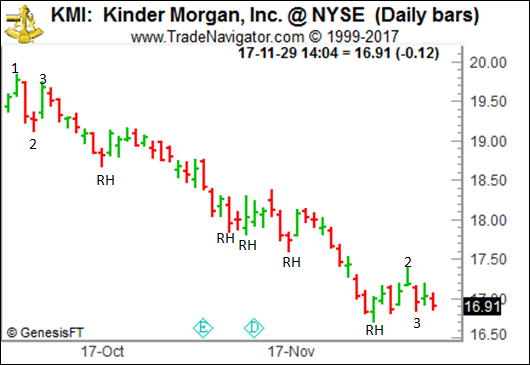
I can't recall how many times I have said or written, "Trade what you see, not what you think." In fact, those very words have become my motto. In this week's Chart Scan, let's look at the obvious — an easy trade that requires nothing more than the willingness to take a look. So many traders have their noses buried in indicators that it is a wonder they don't suffocate. If you look at the daily chart shown below, you will see that once prices violate a #2 point and then violate a Ross Hook, you can expect at least one more hook violation and often two. However, be careful about expectations once prices have violated a third Ross Hook. The violation of a third hook is generally very near the end of a move. From there prices make a 1-2-3 formation at least temporarily ending the trend, or simply consolidate for a while. In the case below, prices made the 1-2-3 after a violation of the fourth hook.
People come from humble beginnings to achieve wealth, status, or fame. But to get ahead, successful people often had to break conventional rules. This readiness to break the rules is often associated with an affinity toward risk. Although they may achieve success, they may also have a shaky self-image. Sure they achieved a lot, but a voice deep inside their psyche still questions their self-worth or competence. They don't have the birthright and the psychological security that matches their current status in life. They beat the odds and they know it, but they never quite feel secure. Their demons lurk in the back of their mind, ready to take over.
Everyone has his or her talents. Some people are intelligent. Other people are natural born athletes while others have physical attractiveness that turns heads. The identity you form early in life can give you an ego boost when you need it, but may throw you off when you are under pressure. Bill Clinton, for example, described himself as an unattractive dork in his autobiography, "My Life." His early self-image didn't match his later success, and his hidden demon lurked below the surface. His need to validate his attractiveness and desirability led to his downfall.
Many people have insecurities and demons that can come out when they least expect them. If you question your intellectual ability, for example, you may be prone to question your trading decisions while under stress. A voice in the back of your mind may say, "Who do you think you are? You're not smart enough to completely trust your decisions." Your ability to combat these self-statements depends on your life experiences. Some people conquer their demons while other people try to ignore them. If you pretend they are not there, however, they can catch you off guard.
How do demons exert their power? Many demons have a common core. People with hidden insecurities feel that you don't belong and that they’re identify can collapse at any minute. In contrast, people who have conquered their demons may feel "natural" in whatever they do. Nothing is a big deal. For example, a person raised in the trading environment is more likely to see trading events as commonplace. Trading is natural. It's no big deal. Trading events are not imbued with emotional significance.
Other people have demons that may impact their trading. What are some popular ones? Consider the imposter demon. Imposters feel they don't belong in the trading profession. They feel that they are just faking it. They assume that they are going to get caught at any minute, so they might as well not take anything seriously. Then there is the gambler demon. Gamblers believe that they are just having fun. They like the risk. They like the rush. It's all about living in the moment and getting high. Some demons aren't as deep seated. Consider the slacker demon. Slackers spent most of their early life blowing off responsibility. They didn't do well in school and ended up a success later in life. Because they spent their early life avoiding structure and discipline, they easily entertain the idea of breaking the rules. They are likely to throw out their trading plan while under stress.
How do you fight your demons? First, gain awareness. Demons only impact you when you are not conscious of them. When you are aware of your secret demons, you can neutralize their power. Second, change your self-talk. When you feel unworthy or uncertain, remind yourself that you are worthy. Remind yourself that your effort will pay off eventually and that you should protect yourself and keep working hard. Don't let your demons sabotage your efforts. Gain awareness of them and fight them. You'll stay profitable in the long run if you do.
Philippe Gautier: Administration and New Developments
Developer: Joe Ross
In 2017, conditions were particularly hostile for premium selling, with especially low implied volatility levels. We still managed to reach our objectives.
Safety
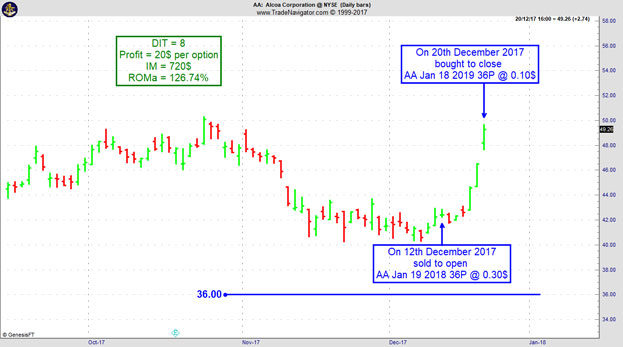
With implied volatility particularly low during the whole year, we had to widen our choice of candidates again, to keep maximum safety. We managed to maintain, on all our trades, a safe distance between price action and our short strikes (see AA and BPOP examples below).
We only had to roll 3 times in 2017 (and all these newly rolled trades are now closed for a profit), as a result of our safety policy. The way we roll now takes a lot of research and is better avoided. This releases more time for back testing, improving Instant Income Guaranteed, etc.
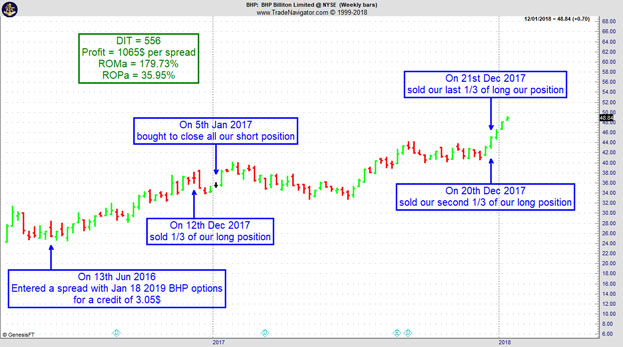
We banked profits on many of our new long term spread trades with unlimited upside potential, always using other people’s money. We recently closed a trade on BHP for instance, which lasted 556 days in total, giving us annualized returns on margin of 179.73% and on principal of 35.95%. This is a very low stress way of yielding 35.95%/year on your cash, maximizing your profits along the way. The only “risk” in this trade was to acquire BHP for a net price of 16.50$ (BHP was quoting 48.84$ on 9th Jan 2018).
As of the 9th January 2018, we have completely closed 8 of these trades and we have 25 of them still opened (out of these 25 trades, 12 have no more margin requirements as we bought to close for a profit the short legs).
In the last few months of the year, I put my efforts on 2 main topics:
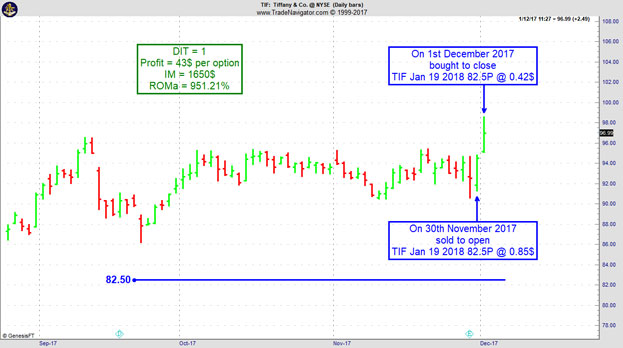
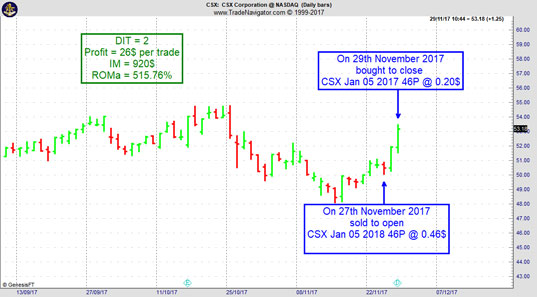
Enter our trades closer to the beginning of a daily uptrend, which allowed us to get higher capital efficiencies and returns, in spite of a particularly low implied volatility (see TIF and CSX examples below):
Refining a new promising spread trade type, much shorter term than the initial one, with excellent annualized returns; after back testing, we entered our first live trade of this type the last trading day of the year.
Wishing you all a great trading year,
Philippe
Receive daily trade recommendations - we do the research for you!
Marco Mayer explains the "Outside Bars" pattern as an entry signal. He shows you how if it works as an entry signal in the Russell 2000 Mini Future and how to evaluate entry signals in general by using a systematic approach.
To view previous published Chart Scan newsletters, please log in or click on "Join Us,"
shown above, to subscribe to our free "Members Only" section.
A WEALTH OF INFORMATION & EDUCATION:
Joe Ross-Trading Educators' popular free Chart Scan Newsletter has been published since 2004.
Note: Unless otherwise noted, all charts used in Chart Scan commentary were created
by using Genesis Financial Technologies' Trade Navigator (with permission).
Legal Notice and Copyright 2018 Disclaimer - Published by Trading Educators, Inc.
Chart Scan is a complimentary educational newsletter.
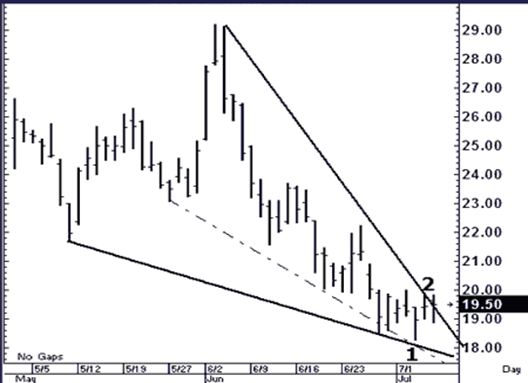
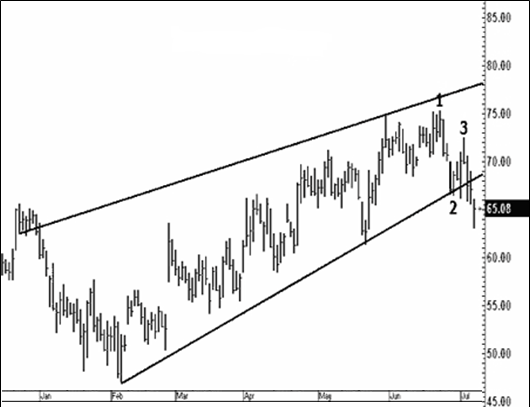
Once in a while I have a longing for the old “geometrical” ways of trading, which for some are still the best ways for trading. What I will show you incorporates the Law of Charts, but it does so while answering a question I received: “What is a bullish descending wedge pattern?” While I’m at it, I’ll show you a bearish ascending wedge.
As you can see in the first chart below, the wedge has grown increasingly narrow. Of course, where to begin drawing the wedge is somewhat in the eye of the beholder. I could have drawn the lower line from the May low (dotted line), and I could have gone way back to the high that occurred in November (not shown). I think you get the idea. The interesting thing is that as the wedge has narrowed, we see the beginning of what may turn out to be a 1-2-3 low. If I had room (I don’t’) I could also show you that from a technical point of view there is a rising trend line on MACD, indicating divergence.
The next chart below shows a narrowing rising wedge. Amazingly, prices have been trading at 300 times earnings! It stubbornly resisted the forces of gravity until just this week, when it formed a 1-2-3 high. Could we see more selling ahead? Could the descent be severe? It will be interesting to find out. But at least now you know what the old-timers called ascending and descending wedges. To make money out of these still requires good management. It is always challenging to see some traders make money from a trade while some traders lose money from the very same trade.
Why do you trade? Most people would think it's obvious. It's for the money, right? What many winning traders know, however, is that money is a poor motivator in the end. It's much more satisfying to pursue trading for the pure joy of mastering the markets, regardless of how much money you make. Winning traders are motivated more by the process of trading than by the profits they are making. It's common to hear traders say, "I love trading so much that I would do it for free if I had to." Indeed, when one looks into the backgrounds of top traders, the story seems to be the same: They all tried to get a job in the trading industry as soon as possible, any job as long as it involved trading in some way. The markets fascinated them. The money was either secondary or not an issue at all. Successful traders love the challenges the market offers and view their work as meaningful.
Consider what Ben, a successful trader, said about money to our TE staff, "Money doesn't make a person happy. Trading is what I do and I enjoy doing it. The money aspect of it is obviously cool and everybody wants that, but I don't know how to do anything else." Staying detached and apathetic towards money can help put you in the proper mindset. Curt, a successful winning trader wrote in to say, "One of the reasons I was successful was because money wasn't the reason I wanted to trade. Because the allure of money wasn't the reason I was trading, it was a lot easier for me to withstand the ups and downs of the market, and to execute without that affecting the way I was executing." When you aren't worried about the money, you can take a more carefree approach to trading. You feel that you don't have to win, and knowing you can make a mistake here and there allows you to relax and trade more creatively.
In modern society, we are pushed to make money. We think we need money, and see trading as a way to make a lot of it. Ironically, if you are focused only on the money, you will become disappointed and eventually fail. Pursuing trading as a passion is a more satisfying way to trade. It's more useful to focus on pursuing goals that are intrinsically interesting and personally meaningful. One should pursue trading because he or she enjoys the intellectual challenge. Market action is intrinsically interesting. It is a rewarding intellectual challenge to devise innovative new trading strategies and to see how well your ideas pan out, just for the fun of it. Viewing trading from this perspective can powerfully motivate you.
Whether it's art, sports, or business, the folks at the top are not primarily motivated by fame, glory, respect, or status. They are driven by the pure love of the game. Winning traders, similarly, have strong interests in the markets, and this passion is the driving force that puts them at the top, year after year. Those who find trading intrinsically satisfying, enjoyable, and meaningful will put in the necessary hard work and achieve high performance levels. So don't focus on the money and status that successful trading may bring. Enjoy the process of trading. Seek out challenges and the satisfaction of meeting them. You'll end up more profitable by doing so.
Philippe Gautier: Administration and New Developments
Developer: Joe Ross
Trade with No Losses
WDC Trade
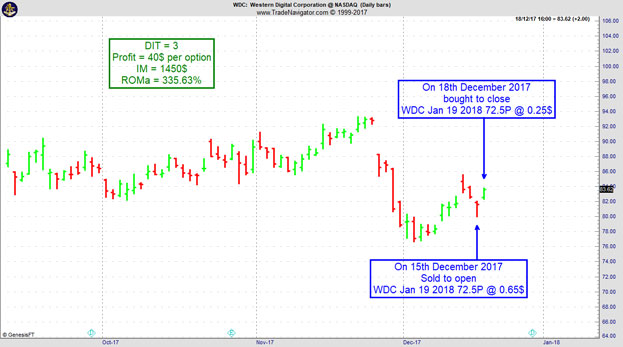
On 12th December 2017 we gave our Instant Income Guaranteed subscribers the following trade on Western Digital Corporation (WDC). Price insurance could be sold a few days later on temporary weakness:
On 15th December 2017, we sold to open WDC Jan 19 2018 72.5P @ 0.65$ (average price), with 34 days until expiration and our short strike about 11% below price action.
On 18th December 2017, we bought to close WDC Jan 19 2018 72.5P @ 0.25$, after 3 days in the trade for quick premium compounding.
Profit: 40$ per option
Margin: 1450$
Return on Margin annualized: 335.63%
Kind regards,
Philippe
Receive daily trade recommendations - we do the research for you!
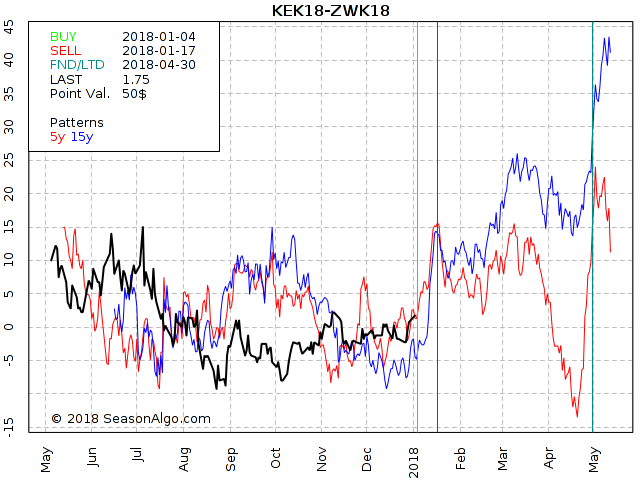
This week, we're looking at KEK18 – ZWK18: long May 2018 Kansas Wheat and short May 2018 Chicago Wheat (KCBT on Globex).
Today we consider a Wheat Inter-Market spread: long May 2018 Kansas Wheat and short May 2018 Chicago Wheat. This trade is simply based on the seasonal statistic. With 22 winning trades in a row it looks promising. This trade should work out immediately because the seasonal time window (01/04 – 01/17) is really small.
Learn how we manage this trade and how to get detailed trading instructions every day by subscribing to Traders Notebook!
In this video, Marco talks about one of the most common, and also one of the most deadly mistakes traders can make, and that's averaging into a losing position. He also gives you some insights as to why this is so tempting, and shows you why you should avoid it at all costs.
To view previous published Chart Scan newsletters, please log in or click on "Join Us,"
shown above, to subscribe to our free "Members Only" section.
A WEALTH OF INFORMATION & EDUCATION:
Joe Ross-Trading Educators' popular free Chart Scan Newsletter has been published since 2004.
Note: Unless otherwise noted, all charts used in Chart Scan commentary were created
by using Genesis Financial Technologies' Trade Navigator (with permission).
Legal Notice and Copyright 2018 Disclaimer - Published by Trading Educators, Inc.
Chart Scan is a complimentary educational newsletter.
With 2018 upon us, it's time to make plans for having a fruitful and productive new year. We have only a few days left before a new year of trading starts. It is a time to rejuvenate and re-energize, and one of the best ways to do that is to clean out all the old stuff you have littering your workstation. Organizing your workspace can make you feel in control, as if you are ready to tackle new challenges.
Clutter, full email inboxes and stacks of old paperwork can be distracting. Saved online articles and piles of newspapers you'll never read can make you feel as if the clutter is closing in on you, cramping your style and stressing you out a little. Removing some of the clutter often symbolically gives you increased psychological space and renewed creative vigor. You'll literally have more room to breathe. Some traders may prefer a messy workspace or unorganized files on their computer, but most people associate untidiness with confusion, chaos, and ultimately, stress. An organized workspace, in contrast, is less distracting. When you are trading, it's essential to focus on your screens. Clutter and disarray can grab your attention and shift it away from monitoring the trade of the moment. A clean, sparse and organized workspace is often refreshing.
It may take a little time and effort, but organizing your workspace pays off. And if you do it systematically, you'll get the job done in no time. The first step in organization is to delete old and throw out worthless information. This is the hardest part. We collect saved documents, books and papers because we think we will need them. Yet many times we accumulate so much stuff that its actual contribution is minimal. We'll never find the time to read all of it, and it will just take up valuable workspace. But it's hard to delete it or throw it away. It took time and energy to assemble these items, and throwing them out subtly suggests that you wasted your time collecting the stuff. But most of it can be tossed out. Make tough decisions and commit yourself to throwing out and deleting anything you don't really need.
For those who still have a love for paper copies, developing an informal filing system can be helpful. It doesn't have to be formal with folders for each topic and precise categories labeling each folder. Sometimes you can merely place documents for a particular task or project in a large attractive looking box. You can then pile the boxes in a corner of your office, or if it is still a distraction, you can stack the boxes in the garage. But it's important to get them off your desk and prevent them from encroaching on your workspace, and more importantly, on your mind.
Get a fresh start on 2018. The first trading day of the New Year is on Tuesday. Spend the rest of the week cleaning things out. You'll feel refreshed and invigorated, and ready to tackle the challenges of the New Year.
Philippe Gautier: Administration and New Developments
Developer: Joe Ross
Another year of price insurance selling is coming to an end. Another year of trading without losses. This is the time for us to stop trading in this low liquidity environment during the last trading week of the year and spend more time with our families and friends. But time decay is still working for us on our existing positions, rewarding us for doing nothing.
2017 was for sure a very interesting year. Because of the missing volatility and direction it was very tough for me to swing trade on the daily chart. Selling options was difficult as well because the Implied Volatility stayed at the lower side of the range in most markets throughout the entire year. Not only trading was tough, I had to fight health issues as well at the last quarter of 2017. But we learn only during tough times and this year I learn a lot. What have I learned? I learned not to take things like money, work, or in general all material things so important and to concentrate much more on health than on anything else. And on family of course. At the end, that’s all that matters!
Regarding trading, I want to concentrate more on spreads again. 2018 will be the 15th year I am recommending spread trades in Traders Notebook and during all these years spreads have been an important part. In 2018, I want to push spread trading even more especially under these trading conditions we are in right now. Hopefully you will join the Traders Notebook Family in 2018!
I wish you and your loved ones a happy and healthy 2018!
I'd like to thank all of you for a great year 2017! Like every year I feel like I’m the one who learned from you or by looking into topics that interested you about trading. It’s amazing how there’s always a new level of depth when it comes to trading that you couldn’t imagine before.
When it comes to actually trading, 2017 surely was a mixed year for me. While Ambush took off to new highs throughout the year in many markets, AlgoStrats:FX drifted into quite a drawdown that surely isn’t what I had expected starting into the year. This lead me to day trade more actively again which happily helped a lot.
I also did my first trades in the crypto currency markets this year and luckily that worked out quite well. Being long the equity markets wasn’t hurting either. But hey, you hardly could fail with that in 2017!
I'll spend the next week over Christmas with my family and friends, far away from the markets. That's what I strongly suggest to do during these days of low liquidity. Just do what everyone else does and relax. After the holidays I’ll go and travel for almost a month and decided to pull the plug completely this time and simply don’t trade at all. This is the first time I’m doing this for many years so I’m really looking forward to this.
So I'd like to wish all of you a Merry Christmas and a Happy New Year! Enjoy the holidays with your family and friends, and I'm looking forward to a great trading year 2018 with you.
While we don’t write articles for the Chart Scan, many of you may recognize us from e-mails and phone calls over the past year as we have had the pleasure of working with students with orders, general questions and guidance. We wish everyone a very successful 2018 and beyond.
To view previous published Chart Scan newsletters, please log in or click on "Join Us,"
shown above, to subscribe to our free "Members Only" section.
A WEALTH OF INFORMATION & EDUCATION:
Joe Ross-Trading Educators' popular free Chart Scan Newsletter has been published since 2004.
Note: Unless otherwise noted, all charts used in Chart Scan commentary were created
by using Genesis Financial Technologies' Trade Navigator (with permission).
Legal Notice and Copyright 2017 Disclaimer - Published by Trading Educators, Inc.
Chart Scan is a complimentary educational newsletter.
"Teach our students the truth in trading - teach them how to trade,"
and
"Give them a way to earn while they learn - realizing that it takes time to develop a successful trader."
Derivative transactions, including futures, are complex and carry a high degree of risk. They are intended for sophisticated investors and are not suitable for everyone.
There are numerous other factors related to the markets in general or to the implementation of any specific trading program which cannot be
fully accounted for in the preparation of hypothetical performance results, and all of which can adversely affect actual trading results.
For more information, see the Risk Disclosure Statement for Futures and Options.